
Home About Basics Casts Theory Verification
References
Contact
50ft oh casts, comparison “dry
fly” vs “nymph”
Purpose
The purpose of this comparison is to show the
impact of changing the fly.
The comparison is made between two
simulations, both having a 20 deg increased casting arc compared to the
reference cast, 50ft oh ref. cast.
· 50ft arc +20 deg, dry fly.
· 50ft arc +20 deg, nymph.
Input, casting stroke
The casting stroke is identical for both simulations with a 20 deg increased arc, see 50ft oh casts with casting arc varied.
Note: When casting a nymph there will be a
“kick” as the leader is straightened. Increasing the casting arc reduces the
“kick” and is often adopted in practice when casting heavy nymphs. Therefore,
an increased arc, in comparison with the 50ft
oh ref. cast, is adopted for this comparison.
The equipment is identical for both simulations, see the 50ft
oh ref. cast, with the fly being the only exception:
· The dry fly has a weight of 47 mg and a terminal velocity at
free fall of 2.5 m/s.
· The nymph has a weight of 188 mg and a terminal velocity at free
fall of 9.3 m/s.
For equal velocities, the air drag for the
dry fly is about 2 times the air drag for the nymph.
Output, animation
Click on the graph below to start animation.

Comment,
animation:
The animation shows the “kick” i.e., the high
downward speed, for the nymph as the leader is straightened. The kick will be
more severe if the casting arc is reduced.
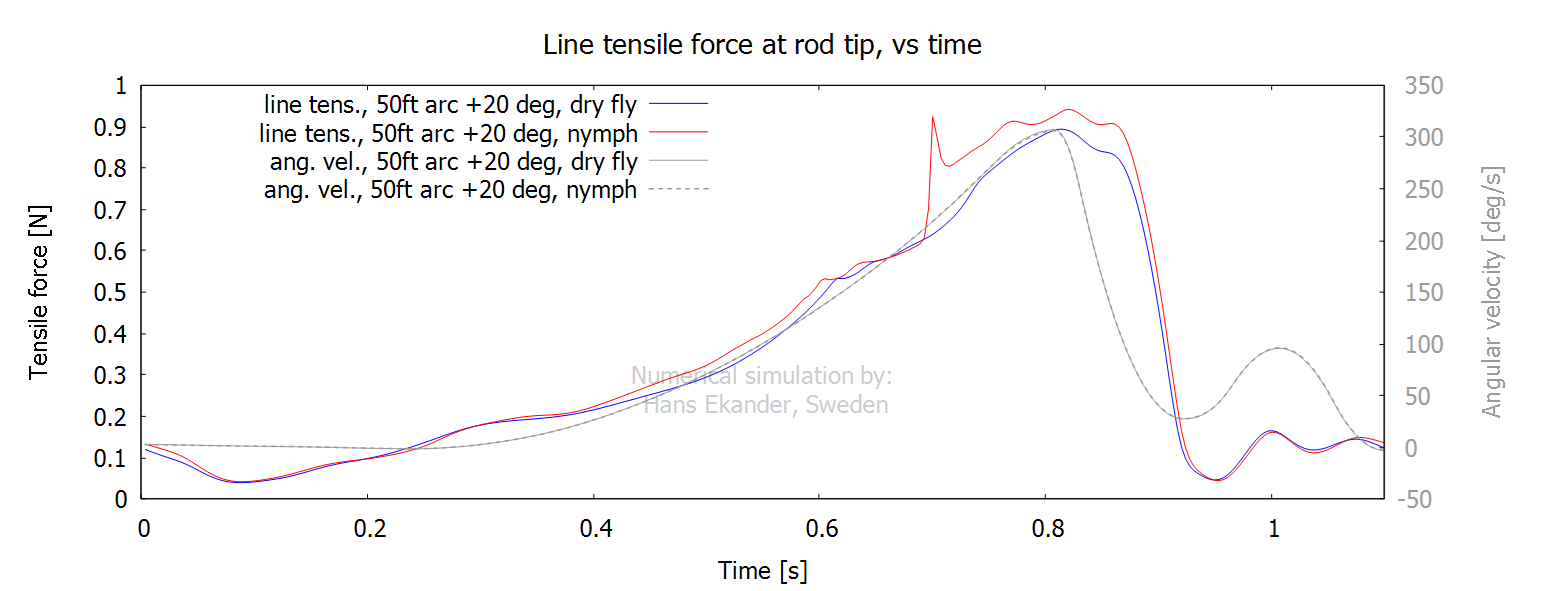
Output, graph
In the graph below, the kick occurs at about
0.7 sec.
Output, energies and work
Differences between the two simulations are
shown below for dissipated work from leader and fly.


Notes:
· The dissipation by air drag from the dry fly is about two times
the dissipation from the nymph.
· With the nymph, dissipation by air drag from the leader is about
two times the leader dissipation for the dry fly simulation.
· The graph at the bottom shows that the sum of the dissipation by
air drag for the leader and the fly is about the same for the two simulations.